
Contents
Sources checked September 30 to October 1, 2026.
Publicly funded cancer clinical research in the United States runs largely through one federal agency, the National Cancer Institute. In fiscal year 2025 the institute had $7.22 billion available [2]. That figure covers everything NCI does, from laboratory science to training, so it is not a measure of trial spending. Most of the money does leave the government: NCI's own overview says the bulk of its budget funds research at universities and research centers [2], through grants and cooperative agreements [1].
Part of that research is clinical trials, and the system that runs them is full of acronyms: NCTN, ETCTN, NCORP, CTSU, LAPS, SWOG, NRG. Each names a different piece, and the pieces are easy to confuse. This article answers one question in order: for NCI-supported cancer trials, who pays, who organizes the work, and how does it reach a hospital and a patient?
The short version: Congress funds NCI. NCI awards money to networks, research groups and sites. The research groups design and coordinate trials. Hospitals, cancer centers and community practices enroll patients. A shared service, the Cancer Trials Support Unit, handles enrollment and regulatory support for many of those trials. This article covers NCI-supported trials specifically, not every cancer trial that receives some public money.
The system at a glance
| Network | What it does | Who organizes it | Typical trial focus |
|---|---|---|---|
| NCTN (National Clinical Trials Network) | Coordinates and supports trials across member sites [3] | Five US research groups plus one Canadian collaborating group [5] | Multi-center, late-phase treatment and advanced imaging trials [4] |
| ETCTN (Experimental Therapeutics Clinical Trials Network) | Runs early-phase trials of new therapies [10] | Eight Lead Academic Organizations with Affiliated Organizations [11] | Safety, early signals of activity and biomarkers [11] |
| NCORP (NCI Community Oncology Research Program) | Brings trials to community settings [12] | Research bases and community site consortia [12] | Cancer control, prevention, screening, symptom management and care delivery, plus NCTN trials [12] |
| CTSU (Cancer Trials Support Unit) | Shared enrollment, regulatory and site support [15] | An NCI-supported shared service listed among CTEP's resources for network sites [15][17]; not a trial group, so it has no research portfolio | Supports trials led by others [8][15] |
Where the money starts: the National Cancer Institute
What NCI is
NCI stands for National Cancer Institute. It is part of the National Institutes of Health (NIH), which sits within the US Department of Health and Human Services as one of that department's 11 agencies [1]. NCI describes itself as the federal government's principal agency for cancer research and training [1].
As a federal agency, NCI receives its money through appropriations from Congress [1]. It spends that money in two directions. Extramural funding goes out as grants and cooperative agreements to outside institutions (a cooperative agreement is a federal award in which the agency stays actively involved in the work). Intramural research happens in NCI's own laboratories and offices in Bethesda, Rockville and Frederick, Maryland [1].
Why a public cancer institute exists
NCI's stated mission is to lead, conduct and support cancer research, and to advance scientific knowledge so that people live longer, healthier lives [1]. Its remit covers research, training and the sharing of information nationwide [1].
For trials, NCI gives a specific rationale. The NCTN is intended to complement, not duplicate, research done by the private sector [4]. NCI lists the kinds of questions where that matters: radiotherapy, surgery and multimodality treatment trials; de-escalation trials that test whether less treatment can achieve outcomes that are not worse than more treatment; studies of treatment sequencing; trials that need an extensive national patient catchment area; trials in special populations such as children, adolescents and young adults; and rare cancer trials [4]. Some of these questions are less well supported commercially, which is one reason NCI maintains a public network [4].
Public funding also carries an access goal. NCI says one purpose of its community program is that people can take part in trials on cancer control, prevention and care delivery regardless of where they live [12].
Who pays for what
Three layers of money are easy to blur.
Institute funding. Congress appropriates funds to NCI, and NCI awards them to network groups, academic sites and community programs [1][3]. NCI says 32 US academic institutions hold Lead Academic Participating Site grants created especially for the NCTN, while community hospitals and medical centers either receive research reimbursement directly from one of the network groups they are affiliated with or receive awards from NCORP [3].
Sponsor and industry funding. Public networks do not work in isolation. NCI describes the ETCTN as a venue for identifying promising treatments to test in late-stage trials funded by NCI and by the private sector [8].
Patient care versus research costs. Even in a funded trial, different payers cover different things. NCI explains that patient care costs, meaning standard care a patient would need anyway, are often covered by health insurance, while research costs, such as the study drug or research-only tests, are often not covered by insurance but may be covered by the trial's sponsor [31].
Funding path
- Congress appropriations
- NCI
- Grants and cooperative agreements
- Networks, groups and participating programs or sites
NCI fiscal year 2025: $7.22 billion
Institute-wide figure covering everything NCI does; not a measure of clinical-trial spending.
Institute funding
NCI awards appropriated funds to network groups, academic sites and community programs.
Sponsor and industry funding
Late-stage trials of ETCTN-identified treatments may be funded by NCI or the private sector.
Patient care vs research costs
Standard care is often covered by health insurance; research costs may be covered by the trial's sponsor.
Money does not follow one identical path for every trial; different payers can cover different costs.
Three networks, three jobs
NCTN: the National Clinical Trials Network
The National Clinical Trials Network (NCTN) is a group of organizations and clinicians that coordinates and supports cancer clinical trials. NCI's network page reports more than 2,200 sites across the United States, Canada and internationally [3], while NCI's clinical-trials overview cites over 3,000 sites [8]. Neither page explains the gap, so treat both as rough scale.
The NCTN grew out of NCI's older Cooperative Group program [4]. NCI announced the launch on March 20, 2014, replacing a structure that was more than 55 years old and funding four adult groups and one pediatric group in place of nine adult groups [7]. The network's primary focus is multi-center, late-phase treatment and advanced imaging trials [4], which NCI describes as large phase II and phase III studies [8].
A phase III trial compares a new treatment against the current standard and, by NCI's description, involves large numbers of participants, from 100 to several thousand [32]. The number of participants and the number of sites are separate measures: NCI notes that a trial may take place in one or two places or at hundreds of different sites [32].
The NCTN has six groups in total: five US groups (four adult, one pediatric) and one Canadian collaborating group, the Canadian Cancer Trials Group [5]. The five US groups get their own section below.
ETCTN: the Experimental Therapeutics Clinical Trials Network
The Experimental Therapeutics Clinical Trials Network (ETCTN) does a different job from the NCTN. It runs early-phase trials of new cancer drugs and drug combinations [10]. NCI's Cancer Therapy Evaluation Program (CTEP), part of the Division of Cancer Treatment and Diagnosis, manages it, and it was created in 2014 [10].
Early-phase trials ask different questions from late-phase ones. NCI describes ETCTN trials as determining the safety of investigational drug combinations, looking for early signals of clinical activity in targeted patient groups, and analyzing biomarkers in depth [11]. Promising findings may go on to larger trials, but the path is not automatic or limited to NCI's own network: NCI describes the ETCTN as a venue for identifying treatments to test in late-stage trials funded by NCI and the private sector [8].
The organizing unit is also different. The ETCTN consists of eight Lead Academic Organizations (LAOs), and each may include Affiliated Organizations (AOs) that partner under its leadership to develop trials and enroll patients [11]. NCI's ETCTN organization page, last updated August 5, 2025, names the eight: City of Hope Comprehensive Cancer Center, Dana-Farber Harvard Cancer Center, the Johns Hopkins Sidney Kimmel Comprehensive Cancer Center, Ohio State University Comprehensive Cancer Center, the University Health Network Princess Margaret Cancer Center, the University of Texas MD Anderson Cancer Center, UPMC Hillman Cancer Center and Yale University Cancer Center [11]. The same page lists affiliated organizations under each one, 43 in all by our count, ranging from 3 under MD Anderson to 9 under Johns Hopkins [11]. It also refers to integrated components that may participate under an LAO's or AO's oversight [11].
NCORP: the NCI Community Oncology Research Program
The NCI Community Oncology Research Program (NCORP) brings cancer clinical trials and cancer care delivery research to people in their own communities [12]. Its main audience is patients treated at community hospitals and oncology practices rather than at a large academic cancer center.
NCI's NCORP overview describes three kinds of components: research bases that provide scientific and statistical leadership, community sites (consortia of community hospitals and oncology practices), and minority and underserved community sites that serve populations with at least 30 percent racial or ethnic minorities or rural residents [12]. The same page gives counts of 7 research bases, 32 community sites, 14 minority and underserved sites and more than 1,000 affiliates in 44 states, the District of Columbia, Puerto Rico and Guam [12]. That page was last updated August 20, 2019, so those figures describe the program as NCI presented it then, not a verified current roster.
The program is also changing. NCI's 2026 funding announcement for NCORP Academic Community Sites describes consortia led by an academic center with a network of community hospitals or oncology practices, with awards anticipated to begin in July 2027 [33]. Until those awards are made, it is a forthcoming funding structure rather than part of today's roster.
NCORP designs and conducts prevention, supportive care and symptom management, screening and surveillance trials, and its community sites also take part in treatment and imaging trials conducted by the NCTN [12]. NCI's Division of Cancer Prevention administers the program [13]. The practical effect is that a patient in a mid-sized city may be able to join an NCI-supported trial without traveling to an academic center hours away. NCI's NCORP Find a Site tool lists the main grantees, with their affiliates and sub-affiliates beneath each [14].
The five NCTN research groups
These groups are organizations that design, coordinate and run trials across many institutions. They are not hospitals. Each has an operations center that develops protocols and manages the group's committees, regulatory work and safety monitoring, and separate statistics and data management centers that handle trial design and analysis [5].
SWOG Cancer Research Network
SWOG began in 1956 in Houston, founded by pediatrician Grant Taylor under an NCI program, as the Southwest Cancer Chemotherapy Study Group. It became the Southwest Oncology Group and adopted its current name in 2018 [19]. It is one of the five US NCTN groups [5]. SWOG says it was the first NCTN member to partner with basic science centers [18].
By SWOG's own account, more than 1,300 institutions and over 20,000 individual members have joined, from large urban cancer centers to small rural hospitals [18]. SWOG credits its trials with contributing to FDA approval of 15 cancer therapies [19], a self-reported figure.
SWOG publishes a searchable institution directory that can be filtered by state and by institution type (Main, split into LAPS and non-LAPS, plus NCORP, Affiliate, Foreign, Special and VA). Each entry carries an NCI code and a SWOG institution number [20].
NRG Oncology
NRG Oncology was formed by bringing together three long-established research organizations: the National Surgical Adjuvant Breast and Bowel Project (NSABP), the Radiation Therapy Oncology Group (RTOG) and the Gynecologic Oncology Group (GOG) [21]. NRG says its legacy groups have more than 150 years of combined experience running multi-institution phase II and III trials sponsored mainly by NCI [21]. It conducts phase I, II and III trials and translational studies across breast, gynecologic, gastrointestinal, lung, brain, head and neck, and genitourinary cancers [21].
NRG publishes the most granular roster of the groups we compared. Its Member Institution Lists page offers rosters by network and state, by CTEP ID, and as a combined list of Main Member, LAPS and NCORP sites, plus a voting member roster [22]. The combined list is dated July 1, 2026, and its columns include CTEP ID, institution name, city, state or province, and member role [23].
ECOG-ACRIN Cancer Research Group
ECOG-ACRIN was formed in May 2012 by a merger of the Eastern Cooperative Oncology Group, a therapy-focused group, and the American College of Radiology Imaging Network, an imaging-focused group, both NCI-sponsored cooperative groups [36]. It describes itself as a membership-based scientific organization that designs and conducts cancer research involving adults who have or are at risk of cancer, and its distinguishing strength is imaging and biomarker science [24]. It integrates imaging and pathology-based biomarker discovery into treatment research and also runs imaging-specific trials for prevention, screening and treatment [24].
ECOG-ACRIN reports nearly 1,400 academic and community cancer centers and hospitals and about 21,000 oncology professionals, and names NCI as its primary funder through the NCTN and NCORP [24]. Its participating-institutions directory is searchable by country, state and institution, or by distance from a location. Each listing shows an NCI-CTEP ID, an "NCI-Member Type" and a separate "ECOG-ACRIN Member Type" [25]. Two membership labels on one record show that NCI's classification of a site and a group's classification of the same site are different things.
Alliance for Clinical Trials in Oncology
The Alliance describes itself as part of the NCTN sponsored by NCI, uniting more than 25,000 cancer specialists at 115 main institutions [26]. It also describes itself as a leading research base for NCORP and reports enrolling more than 40,000 participants [26]. Its mission covers multidisciplinary cancer control, prevention and treatment trials [26].
The Alliance's public Member Institutions page is organized by state or province and then by city. It states that main member institutions may have affiliates that are not listed, and it shows no CTEP IDs [27]. That makes it a useful map of main members and an incomplete roster of sites.
Children's Oncology Group (COG)
The Children's Oncology Group is the NCTN's pediatric group [5]. COG describes itself as a research network focused on improving outcomes for children, adolescents and young adults with cancer, bringing together more than 220 hospitals and more than 13,500 researchers, clinicians and specialists [28]. Its public member-institution directory can be filtered by country and state and shows each institution's address and a CTEP ID [29].
LAPS: the academic hospitals behind the groups
LAPS stands for Lead Academic Participating Sites. NCI's NCTN organization page defines them as academic research institutions that have fellowship training programs and have demonstrated they can enroll high numbers of patients onto NCTN trials [5]. The page names the 32 institutions holding LAPS grants for the project period March 2026 to February 2032, including Johns Hopkins, Memorial Sloan Kettering, MD Anderson, Mayo Clinic, Duke, Yale and Washington University in St. Louis [5]. The page was last updated July 31, 2026, and NCI's NCTN organization page [5] remains the place to read the full named roster.
NCI's funding announcement for the LAPS grants describes the role. LAPS provide scientific leadership by helping develop and conduct trials in association with one or more adult US Network Groups, and they are expected to contribute substantial enrollment across the whole NCTN [9]. Awards use the UG1 cooperative agreement mechanism [9]. That announcement has expired, so it is a record of the funding design, not a list of awardees.
The announcement also sets an eligibility limit that matters for data work. Eligible applicants were academic hospitals or clinic programs providing direct patient care as one integral organizational entity under a single financial management system and governance structure, and the applying organization could not be an NCORP Community Site funded by the Division of Cancer Prevention [9].
LAPS are institutions, not research groups, and they work in association with adult groups [9]. The label also shows up in roster data. NRG's July 2026 list includes LAPS as a member role [23], SWOG's directory separates LAPS from non-LAPS main members [20], and ECOG-ACRIN's directory shows records typed "LAPS Administration" with their own LAPS-prefixed IDs alongside the hospital's ordinary record [25].
CTSU: the shared infrastructure
The Cancer Trials Support Unit (CTSU) is different in kind from everything above. It does not design trials or hold a research portfolio, and sites do not join it the way they join SWOG or NRG. NCI describes it as the service that gives qualified clinical sites access to NCI-funded trials and supports the management and conduct of those trials [15]. NCI's overview describes it as providing a uniform approach to managing regulatory requirements and patient enrollment, with operational support across the networks [8].
The services NCI names fall into a few groups:
- Enrollment. Sites with approved protocol registration and credentialed staff use the Oncology Patient Enrollment Network (OPEN) to enroll eligible patients [15].
- Regulatory support. CTSU supports sites with the regulatory steps needed to open and run network trials [8]. Ethics review itself is done by a separate body, the NCI Central Institutional Review Board (CIRB). An institutional review board (IRB) is the committee that reviews a study's ethics and protections for participants. US sites must use the NCI CIRB as the IRB of record for CTEP-supported and DCP-supported network trials [15], and the CIRB serves more than 1,800 institutions [16].
- Safety reporting. NCI's site resources describe an integration between the Rave data system and CTEP's adverse event reporting system [15].
- Site support. The CTSU website serves as the central resource for site management and trial-conduct questions, and a learning platform supports credentialed staff and investigators [15].
The clearest way to hold the distinction: SWOG develops and leads trials through NCI's concept and protocol review, where network groups submit proposals to CTEP and CTEP staff work with investigators toward protocol approval and activation [35]. The CIRB reviews a trial's ethics, and CTSU is one of the shared systems a site uses to take part.
How the pieces fit together
The simple picture is a chain of funding and organization:
How the pieces fit together
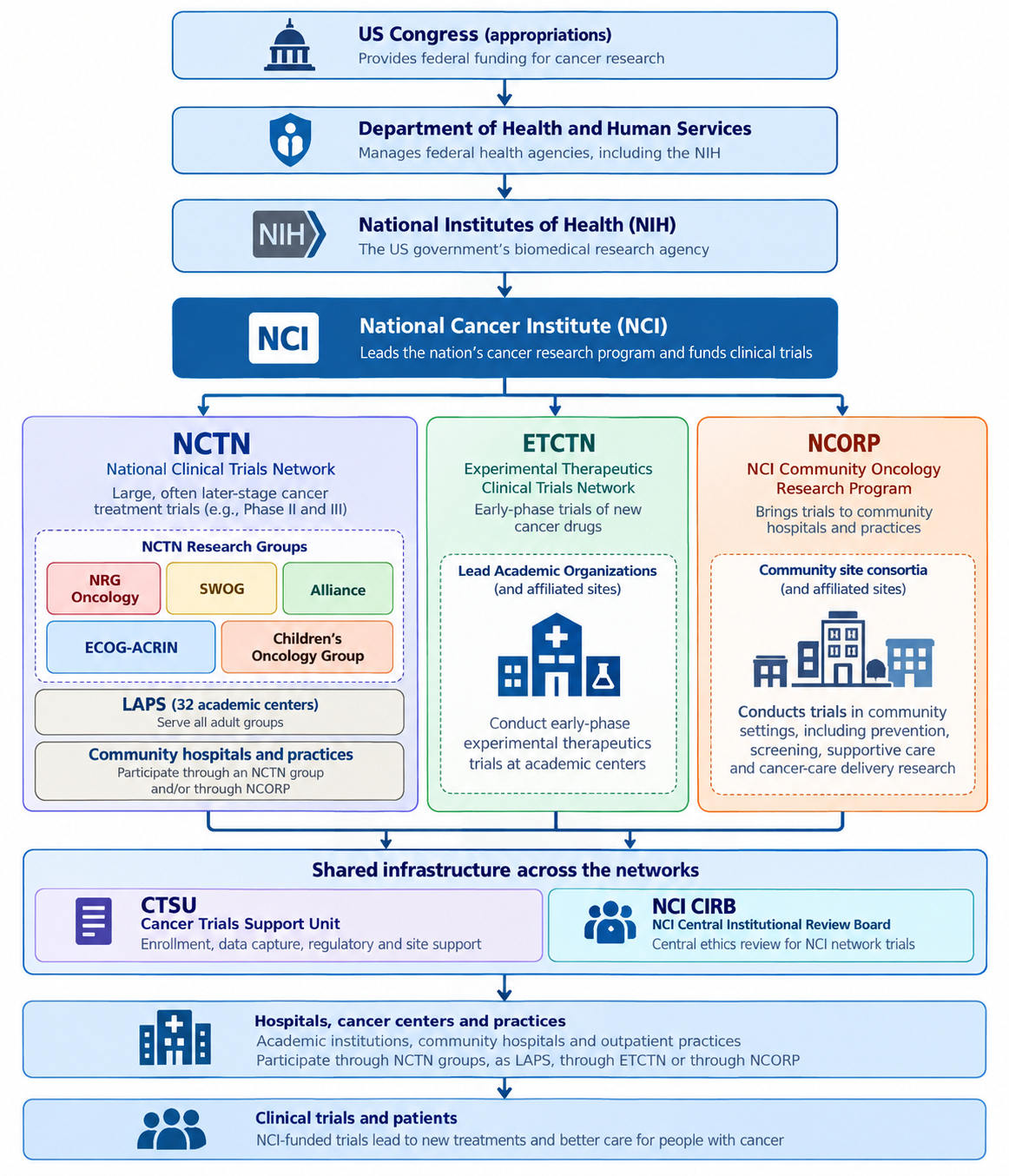
That chain is accurate as a first pass, and NCI's own pages show where it needs refinement.
First, the three networks sit in different parts of NCI. CTEP, within the Division of Cancer Treatment and Diagnosis, manages the NCTN and ETCTN [4][10]. NCORP is administered by the Division of Cancer Prevention [13]. CTEP's resource pages also list a third CTEP-supported network, the Pediatric Early Phase Clinical Trials Network (PEP-CTN) [17], which falls outside this article.
Second, money reaches different kinds of recipients. NCTN awards fund group operations centers and statistics centers, and separate LAPS awards fund lead academic sites [4][5][9]. Community hospitals either receive research reimbursement from the network groups they are affiliated with or receive NCORP awards [3]. ETCTN grants go to its lead academic organizations [11]. None of these is a single pipe from NCI to a hospital.
Third, the networks overlap. NCI says NCORP community sites take part in trials led by the NCTN [12], and NCI's network page describes NCTN participants as coming from LAPS, NCORP sites, other academic centers, community practices and international members [6]. The Alliance is an NCTN group and also describes itself as an NCORP research base, so one organization appears in both networks [26].
One hospital, several affiliations
A hospital can hold several of these relationships, and they mean different things. NCI states that sites can belong to more than one NCTN group, and that membership in at least one group lets a site take part in trials led by any NCTN group for which its investigators are qualified [6]. Membership criteria are set by each group individually [6].
A documented example comes from NCI's own lists. Johns Hopkins's Sidney Kimmel Comprehensive Cancer Center is a LAPS grantee [5] and an ETCTN Lead Academic Organization [11]. Memorial Sloan Kettering is also a LAPS grantee [5], and NCI lists it as an Affiliated Organization under the Johns Hopkins ETCTN [11]. MD Anderson is a LAPS grantee [5] and its own ETCTN LAO [11]. One institution, several roles, each granted separately.
Consider what "affiliation" can mean for a single hospital:
- It may be a member of one or more NCTN research groups (SWOG, NRG Oncology, ECOG-ACRIN, the Alliance, COG).
- It may hold LAPS status, a grant-based designation tied to adult groups [9].
- It may belong to an NCORP community site consortium [12].
- It may be an ETCTN Lead Academic Organization, or an affiliate of one [11].
- It may enroll patients in one specific trial this year, which says nothing about standing membership.
Not every combination is open to every entity. The LAPS notice, for example, barred organizations that were DCP-funded NCORP Community Sites from applying [9]. The labels also attach at different levels: a funded grantee, an affiliate, a campus and a wider health system can each carry different ones. Treating them all as one "network member" label loses information, and treating them as freely combinable overstates what the sources show.
One hospital, several affiliations
Affiliations held at the same time
- LAPS
- SWOG
- NRG Oncology
- ECOG-ACRIN
The affiliations shown are an example of simultaneous relationships, not a claim about a specific hospital. Categories can overlap but are not freely interchangeable, and every relationship must be verified against the relevant official source.
How to read affiliation data
A workable routine for anyone matching sites to programs has four steps:
- Identify the entity. Decide whether the record is a grantee, an affiliate, a campus or a health system.
- Check the official relationship. Use the program's own page or roster: NCI for LAPS, ETCTN and NCORP, and each group's directory for group membership.
- Keep identifiers and dates as recorded. Store the ID exactly as the source prints it, with the source name and roster date.
- Then assess the trial. Whether a site is open and able to enroll in a specific study is a separate question from whether it holds a standing affiliation. A hospital can be a standing member of a group and still not be participating in a given study, so membership only narrows the candidate list. Confirm study participation and site activation, then check protocol-specific approvals, staff credentials and current enrollment capacity.
Four-step affiliation verification
- 1
Identify the entity
Grantee, affiliate, campus or health system.
- 2
Check the official relationship
Use NCI or the relevant network/program directory.
- 3
Keep identifiers and dates as recorded
Preserve the ID, source and roster date.
- 4
Then assess the trial
Standing affiliation does not establish current participation or enrollment capacity.
No tag means unconfirmed affiliation, not confirmed absence.
One consequence follows. A site with no tag in a given category has an unconfirmed affiliation for that category. That is not evidence that the affiliation does not exist.
CTEP site codes: a shared way to name an institution
Hospital names are messy. The same institution can appear as a health system, a cancer center, a specific campus or a legacy name, so NCI-supported networks use site identifiers.
SWOG's membership guidance states that each clinical site participating in CTEP or DCP-sponsored trials must be uniquely identified with a CTEP site code, assigned through NCI's Enterprise Core Unit, which may build the registered name to represent a patient care location [34]. In the directories we compared, ECOG-ACRIN labels the identifier "NCI-CTEP ID" [25], NRG Oncology calls it "CTEP ID" [23], COG shows "CTEP" [29], and SWOG's directory shows an "NCI Code" next to its own institution number [20]. The Alliance's member page shows none [27].
Records should be preserved exactly as printed. Examples include leading zeros in NRG's international entries [23], numeric codes for some of COG's international hospitals [29], and ECOG-ACRIN's separate LAPS-prefixed administrative records [25]. We do not describe a single universal format, because the directories do not follow one.
Where the same code appears in more than one directory, it can help match records that carry different names. Whether SWOG's "NCI Code" is the same code as the CTEP site code elsewhere is not stated on the pages we reviewed.
ClinicalTrials.gov: a useful second check
ClinicalTrials.gov lists trial locations, entered by the people who register each study according to the registry's published data element definitions [30], so it is tempting to use it to work out who belongs to which network. It works better as a secondary check. A listed location shows that a site appears on a particular registration. It does not necessarily say whether that site is a group member, an NCORP site, a LAPS or an ETCTN affiliate, and NCI's description of NCTN membership (group-specific criteria, overlapping memberships) shows why one trial listing cannot settle the question [6]. A listing also does not by itself show how many participants a site enrolled.
For that reason, the starting point is the official lists: NCI's network pages and each group's directory. ClinicalTrials.gov then helps check whether a listed site has appeared on relevant studies.
Why network affiliations matter for site intelligence
A single list of "NCI network sites" obscures important differences. For site intelligence, record the following affiliations as separate, overlapping categories wherever authoritative sources support them. One institution may carry several affiliations.
- SWOG
- NRG Oncology
- ECOG-ACRIN
- Alliance for Clinical Trials in Oncology
- Children's Oncology Group
- LAPS
- NCORP
- ETCTN
The purpose is to make the NCI-supported system easier to explore, so that a reader can find institutions associated with a particular program and see at a glance that one hospital may appear under several.
What the public data does not settle
Some questions stay open because the public sources do not answer them.
- Counts differ. NCI cites more than 2,200 NCTN sites on one page [3] and over 3,000 on another [8]. SWOG's headline figure is more than 1,300 institutions [18], and its directory appears to list more entries than that [20]. No page explains the differences, so counts should be cited with their source.
- Directories are not equally complete. The Alliance list covers main members only [27]. The COG and SWOG directories show no update date [20][29]. NCORP counts on NCI's overview date from 2019 [12].
- Some labels are undefined. ECOG-ACRIN's NCI member types such as "LAPS MM," "LAPS IC" and "LAPS AA" are not defined on the pages we reviewed, and neither is the relationship between LAPS-prefixed records and a hospital's base record [25].
- Integrated components. NCI mentions ETCTN integrated components without listing them [11], so the 43 named affiliates may not be the whole picture.
Key Takeaways
- NCI is part of NIH and receives its money through congressional appropriations. Its fiscal year 2025 funds totaled $7.22 billion, an institute-wide figure that is not a measure of trial spending [1][2].
- NCI says the NCTN complements private-sector research and covers questions such as surgery, radiotherapy, treatment de-escalation, rare cancers and special populations [4].
- The NCTN runs large late-phase trials through five US research groups (SWOG, NRG Oncology, ECOG-ACRIN, the Alliance and COG), plus one Canadian collaborating group [4][5].
- The ETCTN handles early-phase trials of new drugs through eight Lead Academic Organizations and their named affiliates. Later-stage testing may be funded by NCI or the private sector [8][11].
- NCORP brings trials to community hospitals and practices and is administered by a different NCI division than the NCTN and ETCTN [12][13].
- CTSU is shared infrastructure for enrollment, regulatory and site support. Ethics review for network trials is done by the NCI CIRB [15].
- An institution can hold several roles, as Johns Hopkins, Memorial Sloan Kettering and MD Anderson do across the LAPS and ETCTN lists [5][11]. The roles are separate and not freely combinable, so each should be checked against its official source [9].
FAQ
Who pays for NCI-supported cancer clinical trials?
Congress funds NCI through appropriations, and NCI awards money to network groups, lead academic sites and community programs [1][3]. Different payers cover different costs: NCI says patient care costs are often covered by health insurance, while research costs may be covered by the trial's sponsor [31]. Not every publicly funded cancer trial is NCI-supported, and this article covers only NCI-supported ones.
What is the difference between NCTN, ETCTN and NCORP?
The NCTN conducts large, late-phase treatment and imaging trials through its research groups [4][8]. The ETCTN runs early-phase trials of new therapies [10][11]. NCORP brings trials and care delivery studies to community settings [12].
Is CTSU a trial group like SWOG?
No. CTSU is shared infrastructure that supports enrollment, regulatory work and site operations, while the NCI CIRB handles central ethics review. Neither designs or leads trials [15].
What are LAPS?
Lead Academic Participating Sites are academic institutions that NCI funds to give scientific leadership to trials in association with adult Network Groups and to enroll large numbers of patients. NCI names 32 for March 2026 to February 2032 [5][9].
Can one hospital belong to more than one network group?
Yes. NCI states that sites can belong to more than one NCTN group [6]. An institution can also hold LAPS status or an ETCTN role, as several academic centers do [5][11], though award rules can limit some combinations [9].
Can I rely on ClinicalTrials.gov to tell me which network a site belongs to?
It is better as a secondary check. Official network and NCI rosters are the primary source for affiliation, because membership criteria are set by each group and overlap [6].
References
- [1]National Cancer Institute. "About NCI: Overview and Mission." cancer.gov. https://www.cancer.gov/about-nci/overview
- [2]National Cancer Institute. "NCI at a Glance." cancer.gov. https://www.cancer.gov/about-nci/overview/nci-at-a-glance
- [3]National Cancer Institute. "NCI's National Clinical Trials Network (NCTN)." cancer.gov. Last updated February 27, 2026. https://www.cancer.gov/research/infrastructure/clinical-trials/nctn
- [4]National Cancer Institute, Division of Cancer Treatment and Diagnosis. "NCTN: NCI's National Clinical Trials Network." dctd.cancer.gov. https://dctd.cancer.gov/research/networks/nctn
- [5]National Cancer Institute, Division of Cancer Treatment and Diagnosis. "NCTN Organization." dctd.cancer.gov. Last updated July 31, 2026. https://dctd.cancer.gov/research/networks/nctn/organization
- [6]National Cancer Institute. "NCI National Clinical Trials Network (NCTN) Structure." cancer.gov. https://www.cancer.gov/research/infrastructure/clinical-trials/nctn/nctn-clinical-trials-network
- [7]National Cancer Institute. "Implementation of the NCI's National Clinical Trials Network." Press release, March 20, 2014. https://www.cancer.gov/news-events/press-releases/2014/nctnlaunch
- [8]National Cancer Institute. "NCI's Clinical Trials Programs and Initiatives." cancer.gov. https://www.cancer.gov/research/infrastructure/clinical-trials
- [9]National Institutes of Health. "RFA-CA-24-033: NCI National Clinical Trials Network, Network Lead Academic Participating Sites (UG1 Clinical Trial Not Allowed)." NIH Guide for Grants and Contracts (expired February 25, 2025). https://grants.nih.gov/grants/guide/rfa-files/RFA-CA-24-033.html
- [10]National Cancer Institute, Division of Cancer Treatment and Diagnosis. "CTEP ETCTN." dctd.cancer.gov. https://dctd.cancer.gov/research/networks/etctn
- [11]National Cancer Institute, Division of Cancer Treatment and Diagnosis. "ETCTN Organization." dctd.cancer.gov. Last updated August 5, 2025. https://dctd.cancer.gov/research/networks/etctn/organization
- [12]National Cancer Institute. "NCI Community Oncology Research Program (NCORP)." cancer.gov. Last updated August 20, 2019. https://www.cancer.gov/research/infrastructure/clinical-trials/ncorp
- [13]National Cancer Institute, Division of Cancer Prevention. "NCI Community Oncology Research Program (NCORP)." prevention.cancer.gov. https://prevention.cancer.gov/research-areas/networks-consortia-programs/ncorp
- [14]National Cancer Institute. "NCORP Sites" (Find a Site). ncorp.cancer.gov. https://ncorp.cancer.gov/findasite/index.php
- [15]National Cancer Institute, Division of Cancer Treatment and Diagnosis. "Resources for Network Sites." dctd.cancer.gov. https://dctd.cancer.gov/research/ctep-trials/for-sites
- [16]NCI Central Institutional Review Board. "About the CIRB." ncicirb.org. https://www.ncicirb.org/about-cirb
- [17]National Cancer Institute, Division of Cancer Treatment and Diagnosis. "CTEP Resources for Clinical Trials in NCI Networks." dctd.cancer.gov. https://dctd.cancer.gov/research/ctep-trials
- [18]SWOG Cancer Research Network. "Our Network." swog.org. https://www.swog.org/our-network
- [19]SWOG Cancer Research Network. "History & Impact." swog.org. https://www.swog.org/about/history-impact
- [20]SWOG Cancer Research Network. "Institutions." swog.org. https://www.swog.org/clinical-trials/institutions
- [21]NRG Oncology. "About Us." nrgoncology.org. https://www.nrgoncology.org/About-Us
- [22]NRG Oncology. "Member Institution Lists." nrgoncology.org. https://www.nrgoncology.org/about-us/member-institution-lists/
- [23]NRG Oncology. "NRG Oncology Main Member / LAPS / NCORP Institutions as of 7/1/2026." nrgoncology.org. https://www.nrgoncology.org/wp-content/uploads/2026/07/NRG-Main-Members-LAPS-NCORP-for-NRG-website.pdf
- [24]ECOG-ACRIN Cancer Research Group. "About Us." ecog-acrin.org. https://ecog-acrin.org/about-ecog-acrin-cancer-research-group/
- [25]ECOG-ACRIN Cancer Research Group. "Find a Participating Institution." ecog-acrin.org. https://ecog-acrin.org/participating-institutions/
- [26]Alliance for Clinical Trials in Oncology. "What We Do." allianceforclinicaltrialsinoncology.org. https://www.allianceforclinicaltrialsinoncology.org/main/public/standard.xhtml?path=/Public/About
- [27]Alliance for Clinical Trials in Oncology. "Member Institutions." allianceforclinicaltrialsinoncology.org. https://www.allianceforclinicaltrialsinoncology.org/main/public/standard.xhtml?path=/Public/Institutions
- [28]Children's Oncology Group. "About." childrensoncologygroup.org. https://childrensoncologygroup.org/about/
- [29]Children's Oncology Group. "COG Member Institutions." childrensoncologygroup.org. https://childrensoncologygroup.org/patients-families/member-institutions/
- [30]ClinicalTrials.gov. "Policy: Data Element Definitions for Registration and Results Information." clinicaltrials.gov. https://clinicaltrials.gov/policy#data-element-definitions
- [31]National Cancer Institute. "Who Pays for Clinical Trials?" cancer.gov. https://www.cancer.gov/research/participate/clinical-trials/paying
- [32]National Cancer Institute. "How Clinical Trials Work." cancer.gov. https://www.cancer.gov/research/participate/clinical-trials/how-trials-work
- [33]National Institutes of Health. "RFA-CA-27-008: NCI Community Oncology Research Program (NCORP) Academic Community Sites (UG1 Clinical Trials Not Allowed)." Full announcement. https://files.simpler.grants.gov/opportunities/e749b186-9043-4eb2-9288-4833ede537f7/attachments/4c389a46-f2d7-4527-90c6-e0945b90ec68/RFA-CA-27-008-Full-Announcement.html
- [34]SWOG Cancer Research Network. "CTEP Site (Institution) Codes." swog.org. https://www.swog.org/member-resources/membership/institutional-membership/ctep-site-institution-codes
- [35]National Cancer Institute, Division of Cancer Treatment and Diagnosis. "CTEP Trial Development and Conduct." dctd.cancer.gov. Last updated July 16, 2026. https://dctd.cancer.gov/research/ctep-trials/trial-development
- [36]Coalition of Cancer Cooperative Groups. "ECOG-ACRIN Cancer Research Group." coccg.org. https://coccg.org/coalition/ecog-acrin-cancer-research-group/